However, in close finishes, the ability to maintain speed through to the final metres can be decisive, as seen in the men’s 400m final at the 2024 Paris Olympics and in several 100m Diamond League races, such as those in London and Rome.
A recent study published in the Journal of Science and Medicine in Sport presents an original perspective on a key variable influencing the deceleration phase, termed the “rate of propulsive force deterioration” (or PFD rate). The study explores its relationship with maximum velocity, deceleration rate, and finishing speed. You can read the full article here.
What is the PFD rate?
At the start of a sprint race, there is a theoretical maximum propulsive force that muscles generate to propel the sprinter forwards and upwards. In earlier studies on the acceleration phase, this force, let’s call it F0, was assumed to remain constant. Under this assumption, a sprinter accelerates to their top speed and holds it, meaning no deceleration occurs. This model has been widely adopted and validly used to describe the velocity-time relationship and to build force-velocity sprint profiles based on acceleration phase data.
However, in race situations, because all outdoor sprinting events (the 100m, 200m, and 400m) involve a deceleration phase this model cannot be used to model the velocity-time relationship in these events; the constant F0 model doesn’t fully capture what happens across these races. Taking a modelling approach, this new study builds on past research by exploring how a sprinter’s F0 might decline from the start to the finish (i.e., the PFD rate), and how that decline impacts velocity during the deceleration phase.
What were the main results?
- Athletes with a greater PFD rate experienced greater deceleration across all events. However, the effect was greatest in the 200m highlighting the importance of a lower PFD rate in this event.
- PFD rate and finishing velocity were negatively correlated across all events suggesting a trade-off. Athletes with higher PFD rates tended to finish with a slower velocity. This relationship was particularly prominent in the 200m and 400m events.
- Sprinters with greater maximum velocities in the 200m and 400m events had higher PFD rates. That is, 200m and 400m sprinters who achieved higher maximum velocities were more likely to experience a greater rate of loss in propulsive force and velocity later in the race (leading to a slower finishing velocity). This relationship was not significant in the 100m. Higher top speeds were not necessarily associated with a higher PFD rate.
Early vs late-race velocity: managing the trade-off
These findings highlight that sprinting is not simply about reaching the highest possible top speed as quickly as possible. It is also about regulating the PFD rate to optimise finishing velocity.
The 200m and 400m results may reflect a functional trade-off to conserve limited energy from anaerobic metabolism. A higher PFD rate, representing a faster rate of energy from anaerobic metabolism, produces greater velocity early in the race and a higher maximum velocity, but often results in a slower finishing velocity. On the other hand, a lower PFD rate may be associated with a lower maximum velocity but help maintain a stronger finish. In essence, the relationship between a more aggressive maximum velocity and a slower finishing speed is mediated by the PFD rate.
Pacing
This trade-off has broader implications for pacing. The 200m sprinters in the study had lower F0 values compared to the 100m sprinters, suggesting they weren’t going “all out” from the start, possibly due to the biomechanical demands of curve running. In the 400m, where maximum effort can’t be sustained over the full race distance, athletes appear to adopt a deliberate strategy to accelerate with submaximal effort. Supporting this theory, the data showed a smaller F0, a lower acceleration constant, and an earlier time to top speed. These findings suggest that greater sprint performance is about generating greater forces for reaching a higher top speed and about how well propulsive force capacity can be maintained throughout the race.
Conclusion and application of the model
The algorithm used in this study can be used to model the velocity-time relationship in races. An example is here.
The Propulsive Force Deterioration rate is a theoretical metric derived from the velocity-time relationship generated from sprinting events. It may provide increased context for understanding sprinting performance in the outdoor events. Where margins are small, the ability to maintain a low PFD rate may be the difference between fading late or finishing fast.
]]>A Paradigm Shift: Performance-Focused Sport
We conducted a 46-month study involving three adolescents with CPHSN in structured swimming exercise where periods of training were followed by periods of no training. All three participants were previously untrained and were not achieving physical activity levels recommended by the World Health Organisation (WHO) at the start of the study. The swimming program they engaged in was designed to be performance-driven - the goal was to enhance sports performance by focusing on swimming skills and increased training load. During the study, participants increased training load to levels consistent with WHO physical activity guidelines and the results were marked:
- Motor function, as measured by the Gross Motor Function Measure (GMFM-66), improved across each training phase. This was opposite to the decline expected to occur based on previous population-based studies.
- Participants improved their swimming performance, significantly increasing average swimming velocity.
- Periods of training withdrawal led to measurable declines in motor function, reinforcing the effect of the training program.
Why Goals in Sport Matter
Setting and pursuing clear goals is an important part of achieving athletic success in athletes with and without disabilities. The competitive nature of sport and the drive to excel fosters discipline, motivation, and personal growth which may ultimately provide:
- A sense of achievement: Rather than focusing on limitations, athletes work toward milestones in speed, endurance, and skill.
- A structured environment: Regular training with coaches and therapists ensures consistency which is important to long-term progress.
- Social engagement: Team settings are important to foster friendships and community connections.
Removing Barriers to Participation
Our article describes the concept of “Para Sport as Medicine” which suggests that intensive, performance-focused sports training can bring about significant functional benefits. However, despite these benefits, performance-focused sport remains inaccessible to many people with high support needs. The study highlights some of the key obstacles that ought to be addressed:
- Lack of specialized training programs. Few initiatives cater specifically to high-support-needs athletes.
- Cost and accessibility. Transportation and coaching fees can be prohibitive.
- Limited representation. Research and mainstream sports programming rarely include non-ambulant individuals, leading to fewer tailored opportunities. To increase participation, we must prioritize investment in adaptive sports programs, increase funding for multiprofessional coaching teams, and create inclusive pathways for athletes of all abilities.
Looking Ahead
While some of the barriers are listed above, there is an important need for further research into barriers to participation including the role that geographical location plays. Accessibility issues may differ greatly between city and remote communities, with transportation, facility availability, and coaching expertise often limited. Understanding and addressing these differences may be crucial to ensuring opportunities for aspiring athletes at grassroots and elite levels. By breaking down barriers, redefining possibilities and building infrastructure, we can increase the likelihood that individuals with disabilities who wish to participate in similar sports programs to the one described here can do so regardless of their location, activity of interest and level of support needs.
]]>Understanding Running Economy
Running economy (RE) is a fundamental concept in distance running and refers to the oxygen cost required to maintain a constant running speed. The lower the oxygen consumption at a given pace, the better the RE, potentially allowing distance runners to sustain higher speeds for longer durations. RE is influenced by various factors, including biomechanics and external conditions such as footwear and running surfaces. Given its importance in endurance sports, optimizing RE has become a key focus in footwear development.
The Spring-Mass Model of Running
The spring-mass model is a widely used biomechanical approach to understanding human running mechanics. The model conceptualizes the body as a mass supported by the legs which behave in a spring-like way by compressing and rebounding with each step. Using this approach, economical running relies on optimizing the elastic properties of the legs to minimize energy expenditure. Footwear can theoretically influence the spring-mass system by altering the stiffness, energy return, ground contact time and other characteristics of the whole system. High-performance running shoes with advanced technologies potentially enhance RE by altering the behaviour of spring-mass characteristics of the system.
Advanced Shoe Technologies
Advances in footwear technology over the last 8 years have revolutionized the running industry by significantly improving RE and performance. Modern performance shoes incorporate high-energy-return midsoles made from advanced foams, which provide superior cushioning and responsiveness while remaining lightweight. The inclusion of carbon fiber plates in these midsoles appears to enhance shoe stiffness and reduces work at the foot and ankle joints. Additionally, rocker designs in modern midsoles may facilitate smoother transitions through the gait cycle, potentially minimizing energy loss. These innovations seemingly work synergistically to improve RE.
A New Approach to Footwear Selection
Traditional methods for evaluating the impact of footwear on RE have primarily focused on group-level effects, averaging results across runners and attributing performance changes to specific footwear properties, such as a thicker or stiffer midsole or increased energy return.
Traditional approaches to evaluating the impact of footwear on RE have primarily considered group-level effects, averaging results across runners, and attributing the average effect to footwear properties such as a thicker or stiffer midsole or greater energy return. However, research shows that individual responses to different footwear technologies vary substantially. To account for the systematic effect of advanced footwear technology and the individual variability, in this paper we propose a theoretical framework that differentiates the direct and biomechanically mediated effects of footwear on RE (see figure below).
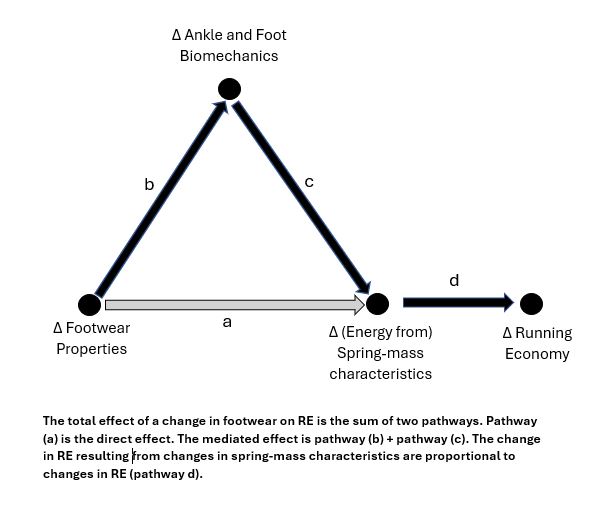
Direct effects: Defined in the paper as “the impact of a change in the mechanical properties of footwear on RE while key biomechanical variables remain constant.” In essence, direct effects refer to changes in the spring-mass characteristics of the runner’s system and RE without altering foot and ankle biomechanics in a systematic way. For example, midsole energy return may directly influence the spring-mass system, and these mechanical effects are relatively consistent across runners.
Biomechanically mediated effects: Defined as “the observed change in RE when holding footwear constant while altering relevant ankle and foot characteristics to match those influenced by different footwear.” In other words, these effects occur when footwear changes impact ankle and foot biomechanics, which in turn alter the runner’s spring-mass characteristics and RE. This framework highlights the importance of personalizing footwear choices based on optimizing an individual’s biomechanically mediated response, allowing for a more precise understanding of how different runners may react to specific footwear technologies.
Interdependence: A key to understanding footwear optimization?
The concept of interdependence is central to the framework. Interdependence is the concept that many natural processes do not have easily discernible boundaries and are therefore difficult to isolate from each other. In this paradigm, the effect of footwear properties and the effect of an individual’s biomechanics are not isolated factors but are dynamically constituted. For example, the impact of a highly resilient midsole on RE is not merely a function of its energy return as measured in benchtop tests. Instead, the actual effect dynamically integrates with the runner’s leg spring mechanics. Recognizing and understanding the limits of this interplay enables a more tailored approach to footwear selection. Instead of recommending the same high-performance shoe to all runners, manufacturers and athletes would be able to assess how specific footwear technologies interact with an individual’s biomechanics to optimize RE.
Potential Benefits of This Framework
- Personalized Footwear Selection: A greater understanding of the biomechanically mediated effects would allow runners to choose shoes that optimises RE and performance based on their physical and biomechanical characteristics.
- Enhanced Shoe Development: A greater understanding of the direct and mediated effects would allow manufacturers to design footwear technologies that not only offer greater mechanical advantages but also offer optimisation for runners with different biomechanical patterns.
- Scientific Advancements: Researchers can develop better testing methodologies to quantify and separate these effects, improving our understanding of footwear biomechanics.
- Regulations: An understanding of these effects may reinforce current regulations of competitive distance running shoes.
Conclusion
The individualization of footwear for optimizing running economy represents an exciting evolution in sports science. By distinguishing between the direct and biomechanically mediated effects of footwear, this framework may provide a roadmap for footwear manufacturers, researchers and distance runners to understand the effects of footwear on RE and performance. As future studies refine these principles, runners may be able to look forward to more personalized and effective footwear options tailored to their specific needs.